Trip dates: April 20 - 23, 2012
Day 1:
Dominica (not to be confused with the Dominican Republic) is not exactly your typical Caribbean island. Instead of golden sand beaches, the island's main attraction is that it is covered in rain forest, with dramatic peaks peaking out from the mist. According to the guidebook, this difference is visible already from the air, but I wouldn't know, as we are landing in the dark. We have just arrived on a 30 minute flight from St Lucia, witnessing an amazingly beautiful sunset in the air.
 |
| Sunset from the plane |
We land at the modern Melville Hall Airfield, and wait for the hotel driver to pick us up. First lesson about Dominica, punctuality is optional here. Soon we learn the second lesson of the island, as the driver warns us about car-sickness. The roads are incredibly curvy, narrow and potholed here. Not what I want to hear, because I do suffer from car-sickness, so I spend most of the 60 minute drive with my eyes closed. When I do occasionally look out the window I can tell, even in the dark, how incredibly lush the vegetation is. Two thirds of the island are blanketed by dense forest like this.
It was raining when we landed and by now it is pouring. Jokingly the driver explains that they have two seasons here, the rainy season and the not-so-rainy season. We are here during the latter, so it's unusual that is has now been raining for days, and pretty much pouring all day. Again, not what I wanted to hear. I ask him what the forecast is for tomorrow and he bursts out laughing: "we don't go by that".
We drive through the Carib Territory, a 3700-acre reservation, residence of the Caribbean's only remaining tribe of Carib Indians. According to the guidebook, the island's challenging landscape made it difficult for the British and French to take over the entire island, so the Caribs did not have to leave, they simply retreated to this part of the island. I am curious, so I open my eyes quite frequently, but there is not much to see from the road. We pass by some residential areas and a whole row of empty stalls, which, I assume, sell handcrafts during the day.
Finally we arrive to Rosalie Bay Resort, an eco-luxury hotel, where the "eco" part includes LED lights, chairs made from recycled materials, sustainably-produced cotton towels, UV-filtered natural spring water and organic cuisine based on produce grown in the hotel's own organic garden. Also let's not forget the solar panels, wind turbine (the first on Dominica), and the hotel's sea turtle protection effort (also first on Dominica). I am excited. I have never stayed in a resort with such level of eco-friendliness. And, based on the hotel's advertisement I have seen on every single LIAT flight we have taken on this trip (literally, every single flight), the place should be lovely.
A bowl of fresh fruit (I assume organic) awaits us in our cottage, but we are too tired to appreciate it. Tomorrow.
 |
| Reception of Rosalie Bay Resort |
 |
| Wind turbine of Rosalie Bay Resort |
Day 2:
We wake up to the sound of pouring rain pounding on the roof, luckily it stops soon. Yesterday we arrived in the dark, so now we gasp when we open the curtains. The view is beautiful, and the morning mist gives it a magical touch.
 |
| Morning view from our cottage at Rosalie Bay Resort |
On our way to breakfast we pass people doing yoga at the riverside pavilion, then pause a little bit to take in the magnificent view of the Rosalie River. Breathtaking!
 |
| Rosalie River with yoga pavilion |
 |
| Rosalie River |
 |
| Rosalie River |
Breakfast is delicious, with excellent fresh fruit and fresh mango juice. I am feeling adventurous, so I try Kalinago Farine Porridge, which, according to the menu "is a traditional dish made from the fiber of the Cassava after the starch has been removed". The consistency is pretty much like hot oatmeal. The taste....well, it's an acquired taste. The first spoonful is not terribly enjoyable, the second is OK, by the third I quite like it.
 |
| Kalinago Farine Porridge |
Bev, a lovely American lady who owns the hotel, stops by our table for a chat. Then we walk out to the spot where the Rosalie River flows into the Ocean. It is so beautiful here. I am truly starting to fall in love with the place.
 |
| Delta of Rosalie River |
 |
| At the delta of the Rosalie River |
We are keeping our eyes open, as the Green turtles are sometimes seen feeding here, but we don't see any. The owners of the resort established the first sea turtle protection effort in Dominica, and between March and October three species of these endangered animals nest on the black sand beach here. We are visiting in April, so we sign up for the hotel's turtle-alert, meaning if a turtle comes ashore in the middle of the night, we will be woken up to see it. While I generally don't appreciate being woken up from deep sleep, I would love to see a nesting turtle for the first time in my life. Let's hope.
Even though we don't see any turtles, we do see lots and lots of crabs and lizards.
 |
| Crab at Rosalie Bay Resort |
 |
| Lizard at Rosalie Bay Resort |
 |
| Lizard at Rosalie Bay Resort |
After a quick stop at reception to arrange for a rental car and to meet Bev's partner Oscar, it's off to the pool. The rain stopped, the sun is blazing. By the poolside we are entertained by some funny looking birds, which remind me of the Kiwi birds of New Zealand. They run quite fast, and, unlike the Kiwi, they also fly. They seem quite territorial and we watch them for a while. I never found out what they are called though.
 |
| Kiwi-looking bird poolside at Rosalie Bay Resort |
After a lunch of fresh vegetables we walk a bit on the hotel grounds. No sign of turtles, but, to our daughter's delight, there is a maze, which entertains her for a long time.
 |
| Maze at Rosalie Bay Resort |
It's time to pick up our rental car when the downpour starts again, so we hide out on the veranda of the reception building. Perfect time to take pictures of the flowers which surround us. They are magnificent. All my attempts to take pictures of the fast-moving hummingbirds end in failure though.
 |
| Flowers - Rosalie Bay Resort |
 |
| Flowers - Rosalie Bay Resort |
 |
| Flowers - Rosalie Bay Resort |
 |
| Flowers - Rosalie Bay Resort
|
 |
| Plants - Rosalie Bay Resort |
Did I mention that punctuality is optional here? But, by the time the rain slows down, our rental car arrives as well. The only small problem: the driver's seat-belt is stuck. After about 30 minutes of trying to fix it, the rental agent promises that he will take care of it tonight. I have read on the US State Department website that "seat-belt laws are not strictly enforced" here, but we would still prefer to have a functioning one. Oh well. Luckily this afternoon we don't have to drive far.
Emerald Pool, Dominica's most popular natural attraction is only a 15 minute drive away. The directions we get from the hotel staff couldn't be simpler: follow the (only) road from the hotel, then turn right at the bright-blue bus stop. OK, we can do that. The road is curvy with plenty of potholes, so, to accommodate my sensitive stomach, my husband is driving very slowly. Just as well, because the scenery is absolutely beautiful. From the bridge by the hotel we get a fantastic view of the Rosalie River, and then it's through lush greenery all the way.
 |
| View of Rosalie River from the bridge by Rosalie Bay Resort |
 |
| Drive from Rosalie Bay Resort to Emerald Pool |
 |
| Drive from Rosalie Bay Resort to Emerald Pool |
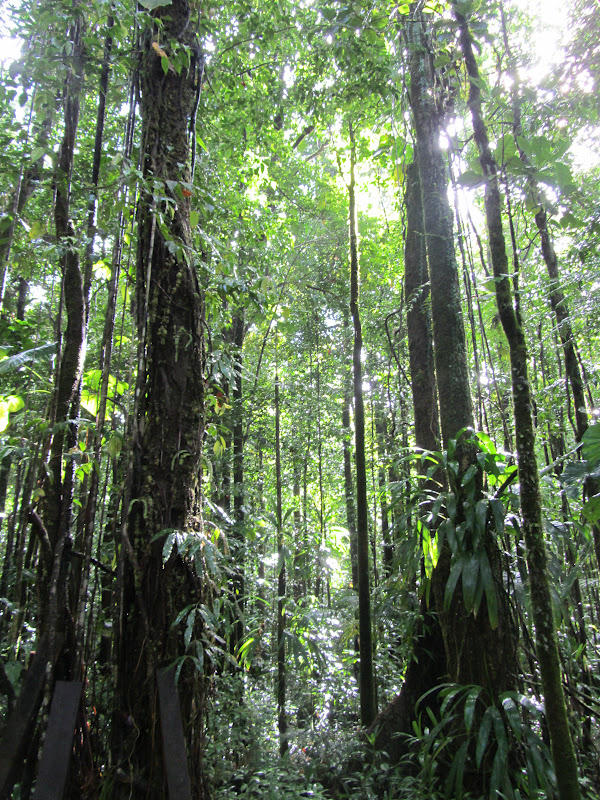
The Emerald Pool is within the Morne Trois Pitons National Park, a 16,000-acre UNESCO World Heritage Site. There is an entrance fee to enter the jungle trail, which, after a 15-minute walk, reaches the waterfall and pool. According to the guidebook, the paved sections of this pathway are remainders of a Carib trail. I can't help but be amazed by the beautiful nature around us. We are only a couple of minutes from the road, but it feels as is we were in the middle of the jungle.
 |
| Trail leading to Emerald Pool |
 |
| Trail leading to Emerald Pool |
 |
| Trail leading to Emerald Pool |
 |
| Trail leading to Emerald Pool |
 |
| Trail leading to Emerald Pool |
 |
| Trail leading to Emerald Pool |
 |
| Trail leading to Emerald Pool
|
The pool is not exactly emerald, just greenish (perhaps the light-conditions are not good today?), but with the lush forest and waterfall is a pretty sight. After some initial hesitation we hop into the freezing cold water. It's lovely here, and after a while we have the whole place to ourselves. We have heard that on days when a cruise boat docks on the island this pool is unbearably crowded. But there is no boat today (we checked with hotel staff before we set out), so it's peaceful and quiet.
 |
| Emerald Pool |
 |
| Emerald Pool |
In the parking lot souvenir stalls we manage to find some (expensive!) postcards, then it's back to the hotel via the same beautiful drive. Some fresh fruit on the terrace of the cottage, admiring the view. Lovely dinner, than we call it a day.
 |
| Our car has a little visitor |
Day 3:
The rain has been pounding on the roof all night and in the morning it is pouring. So we take our time with breakfast. When the rain slows we set out. We are relieved to find that the rental agency has kept their promise and the seat belt is fixed.
 |
| Pouring rain at Rosalie Bay Resort |
 |
| Pouring rain at Rosalie Bay Resort
|
Today it's back to the Morne Trois Pitons National Park. The park has plenty of interesting spots, but some of them are a bit difficult to access. Such as the famous Boiling Lake, a 63-meter (207 feet) wide cauldron, with bubbling grey water and vapor. Apparently the Boiling Lake is the largest of it's kind on the world, so I would love to see it, but it's only accessible via a full-day trek, not appropriate for our 8-year old daughter. I am flirting with the idea of the 45-minute walk to Middleham Falls, one of the largest waterfalls on the island, but hotel staff do not recommend it after the heavy rain.
So we opt for the most touristy of all options, the twin Trafalgar Falls. But first we have to make it there. Our hotel is located at the foothills of the national park, but, due to the lack of roads, we need to cross the entire width of the island and then circle back toward the falls. I don't mind, the scenery is beautiful. The road is narrow, winding and potholed, but as we get closer to the west coast it suddenly becomes better. Perhaps because we are closer to the capital Roseau. Or is it because this stretch of the road connects the cruise boat terminal with the Emerald Pool? It is also more dry here in the west. Just as well, at least it's not raining like in the resort.
Driving from Rosalie Bay Resort to Trafalgar Falls
 |
| Driving from Rosalie Bay Resort to Trafalgar Falls |
As soon as we reach the west coast we fill up the gas tank, as apparently the gas station on our side of the island is closed (is there really only one?). After about 45 minutes of driving, we approach the capital city of Roseau, and the first thing we see is a large cruise boat docked in the port. That is bad news for us. Cruise boats mean crowds.
 |
| West coast of Dominica |
We drive around town for a while, looking for our turnoff. Signs are virtually nonexistent, luckily the locals are very friendly and always willing to point us in the right direction. Finally we find the correct road and it becomes instantly obvious that we are going the right way, as we are in the company of dozens of numbered minivans, shuttling cruise boat passengers to Trafalgar Falls.
 |
| Roseau waterfront |
 |
| Driving through Roseau |
Then suddenly the realization: we haven't seen any minivans in a while. Are we still going the right way? No, of course we are not. We missed our turnoff again. We end up driving deeper into the National Park than planned, but we don't mind. We are not in a hurry and the scenery is beautiful. Plus, by accident, we get to visit the highest road point on Dominica. The only source of worry is the sound our 4x4 is making while climbing the hills. We are not at all sure that it will make it, but it does.
 |
| Morne Trois Pitons National Park |
 |
| Morne Trois Pitons National Park |
 |
| Morne Trois Pitons National Park - the highest road point on Dominica |
 |
| Morne Trois Pitons National Park
|
After some careful study of the map we think we know where we should be going, so we return to the fork and take the road in the other direction. It takes us to the village of Laudat, not at all where we were planning to go. There are some teenagers hanging out in a backyard, and I get out of the car to ask for directions (again). As soon as the car door opens the sulfur smell hits us, a sure sign of the area's geothermal activity.
The directions we get are: follow the road then turn left at the orange house. While this is correct (there really is an orange house at the turnoff) it is a bit vague, as there suddenly seem to be too many orange houses on the island. That means that we have to ask for directions 3 more times and get our wheel stuck in mud once before we finally find it. No, not the falls yet, but the road full of tour group minivans. Yes! Follow those vans!
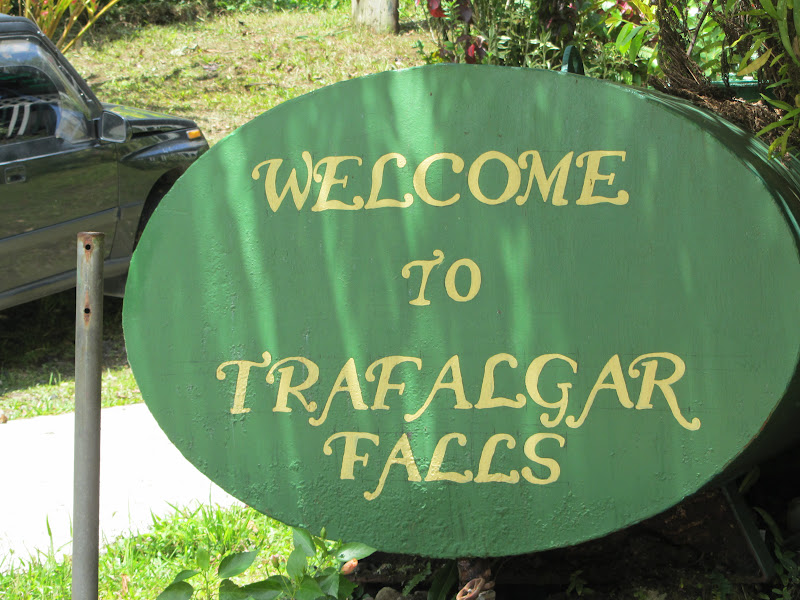
And then, finally there it is! The welcome sign to Trafalgar Falls and the parking lot full of minivans. The place is absolutely crowded with tourists, which makes the walk to the falls much less enjoyable. The viewing platform is completely full, and we have to wait for a while for our turn to take a picture with the falls. We hang out for a while, which turns out to be a good decision, as we catch a short period between groups when the platform almost completely empties out. We take advantage of the sudden quiet to thoroughly enjoy the view of the twin falls.
 |
| Trafalgar Falls |
 |
| Trafalgar Falls |
 |
| Trafalgar Falls |
 |
| Trafalgar Falls
|
We decide against bathing because it's too crowded for our taste. We head back to the hotel, this time taking all the correct turns.
In Roseau, outside the large sports stadium, there is a cricket practice, and I wonder if it's one of the teams playing tomorrow. The match between West Indies and Australia is taking place here, and we have been hearing about this ever since we stepped foot on the island.
 |
| Roseau stadium |
We are back in the hotel for a mid-afternoon lunch and it's raining again. It's Earth Day today and a group of local schoolchildren are doing beach cleanup, then participating in a lecture in the resort. We walk to the black sand beach to join the cleanup, but we are late, they have just finished. So we stroll around the beach, then stop at the hotel spa, where our daughter can finally get some (outrageously) pink nail-polish she has been nagging us about.
 |
| The black sand beach at Rosalie Bay Resort |
 |
| The black sand beach at Rosalie Bay Resort |
Day 4:
There was no wake-up call for turtle-watching last night, which means that today we are leaving without having seen nesting turtles.
The hotel restaurant serves us breakfast before opening time, then we set out driving to the airport. This time, in the daylight and with my eyes open (thanks to some motion-sickness medication) I can finally enjoy the surroundings. Just like before, the roadside is incredibly lush, simply beautiful. Greenery everywhere. And we also pass some dramatic coastline along the way.
It starts raining (of course) and we do have to ask for directions twice (of course). But it's a pleasant drive. It's morning, and there is the usual hustle and bustle of people going to work, children walking to school.
 |
| On the road from Rosalie Bay Resort to Melville Hall Airfield |
 |
| On the road from Rosalie Bay Resort to Melville Hall Airfield |
 |
| On the road from Rosalie Bay Resort to Melville Hall Airfield |
 |
| On the road from Rosalie Bay Resort to Melville Hall Airfield |
We leave the rental car keys with the airport security guard, pay our departure tax, then it's off to the next stop in our island hopping.
I am so grateful for having had the opportunity to visit Dominica. I didn't really know much about the island prior to our visit. In fact, like so many people I spoke to, I kept confusing it with the larger Dominican Republic (embarrassing, I know). But now that I have visited, it ranks as one of my favorite places in the world. Over-development, which changed the character of so many of the Caribbean islands, hasn't changed Dominica yet. And, given their government's focus on keeping Dominica the "Nature Island", let's hope it never will. The island has been recognized by the nonprofit organization Ethical Traveler as one of the World's Best Ethical Destinations. For me it's just a little piece of paradise on earth.