Date: August 2012

We arrive to Kyoto from Osaka after a 15 minute ride on the famous Japanese bullet train, the
Shinkansen. Just like in Osaka, the train station is huge and modern, but some differences between the two cities are visible right away. One: there are hordes of tourists here in Kyoto, while in Osaka there seemed to be barely any. Two: for some reason people stand on the left while riding the escalators, while in Osaka they stand on the right.
We meet our volunteer guides in front of the station. There are multiple free tour-guide services in Kyoto, which I would have not known about, luckily our Japanese friends arranged everything. The guides are students and one of them is only here to be trained and gain some experience.
Kyoto is known as the historical and cultural capital of Japan, with an overwhelming number of beautiful historic sites. Lonely Planet calls it "one of the world's most culturally rich cities", "with 17 UNESCO World Heritage sites, 1,600 Buddhist temples and 400 Shinto shrines." But the first thing we see when we exit the train station is neither beautiful nor historic, it is the modern
Kyoto Tower. Our guide is not very happy with this and simply calls the tower ugly. I think that's a bit harsh, but I agree with Lonely Planet, that the first impression of Kyoto is something of an anticlimax.
 |
| Kyoto train station |
 |
| Kyoto Tower |
Kyoto is a large city, the seventh largest in Japan, and is characterized by urban sprawl. So, to access all the hidden cultural gems, one needs to either take a bus-tour or rely on public transportation. We opt for the latter. We get daily bus passes then hop on a bus to our first sightseeing stop. I am pleased to find that, just like the trains and metros, the Japanese buses are air-conditioned. It is overcast today, but incredibly humid, so I am not sure if I could bare traveling in a bus without air-conditioning. I find their system of ticketing confusing at first, the exact opposite of what I am used to in Paris. In Paris it is only allowed to board the bus through the front door, by the driver, who makes sure that everyone has a ticket. To get off the bus we use the back door. In Kyoto (and perhaps all of Japan?) it's the opposite. We get on through the back door, ride without ever showing our tickets, then get off in the front where the driver checks our tickets as we are exiting. Interesting.
We arrive to
Nijo Castle (Nijo-jo), the 17th century official Kyoto residence of the first Tokugawa Shogun, Ieyasu. Unlike the Osaka castle we have seen yesterday, this one is original, not a reconstruction, and was designated a Unesco World Heritage Site. Unfortunately there is no photography inside, so I can't show you the lovely interior, the beautiful wall and ceiling paintings (there are over 3,000 of them).
Our knowledgeable guide explains the history of the place and the function of each of the rooms. There are 33 rooms in all, grouped into linked sections, starting with the most public ones. This is where the shogun received feudal lords, who were not necessarily his fans. That probably explains why all of these rooms seem to have a "body guard room" concealed behind the screen walls, where bodyguards would wait, ready to pounce at the first sign of trouble. Then we pass to the semi-public section, the Inner Audience Chambers, also reserved for business, but only with trusted allies. The last section is the shogun's private living quarters.
In addition to the handy little body-guard rooms, the shogun also had his own version of an alarm system, the
"nightingale" floors. They are not just your usual squeaky wooden floors, they have a prettier, almost musical sound. They cover the hallways, so that enemies could always be heard coming.
 |
| Higashiotemon Gate, Nijo-jo (Nijo Castle), Kyoto |
 |
| Nijo-jo (Nijo Castle), Kyoto |
 |
| Nijo-jo (Nijo Castle), Kyoto |
To protect the beautiful wall paintings, all sliding doors to the outside must be kept closed. This makes the temperature inside quite unbearable. Why didn't we bring fans? They are giving them out everywhere on the streets of Osaka as advertisement, and by now my 8-year old daughter has amassed a nice little collection of them. Many tourists were smart enough to bring them but we were not. Oh well. It's a relief to get out into the relatively fresh (but terribly humid and hot) air in the garden. Just like at the Osaka Castle, the sound of the cicadas is deafening.
 |
| View of Nijo-jo (Nijo Castle) from the garden, Kyoto |
 |
| Garden of Nijo-jo (Nijo Castle), Kyoto |
We hop on the bus, next stop
Kinkaku, the Golden Pavilion. It is probably Kyoto's most recognizable landmark, and rightly so. It is absolutely gorgeous. Not even the huge number of tourists can take away from the beauty of the place. The pavilion is part of a Zen Buddhist temple officially named
Rokuon-ji, but mostly just called
Kinkaku-ji, the Temple of the Golden Pavilion. Together with the garden the buildings are said to represent the Pure Land of Buddha in this world. The beauty of the place is overwhelming. I have seen pictures of it with fall foliage, and with that it looks almost out of this world. But even on this overcast summer day it's gorgeous.
 |
| Kinkaku (The Golden Pavilion), Kyoto |
 |
| Kinkaku (The Golden Pavilion), Kyoto
|
 |
| The priests' living quarters,
Kinkaku-ji Temple, Kyoto |
The upper two floors of the Golden Pavilion are covered in gold leaf. Why is the bottom floor not covered? According to our guide simply because Zen Buddhism prefers "incomplete". At least I think that's what he is saying. I am too preoccupied by enjoying the view to listen to any explanation.
 |
| Kinkaku (The Golden Pavilion), Kyoto
|
It's starting to rain, but we stroll through the pretty garden anyway. There is a waterfall called
Carp Rock (Ryumon Taki). According to legend, if a carp (as in the fish carp) manages to jump up the waterfall, his dream will come true and he will become a dragon.
 |
| Garden of Kinkaku-ji Temple, Kyoto
|
 |
| Ryumon Taki (Carp Rock),
Kinkaku-ji Temple, Kyoto |
 |
| View of the Golden Pavilion from the garden of Kinkaku-ji Temple, Kyoto |
We take a quick look at the
Sekka-tei Tea House. It's name, Sekkatei, means Place of Evening Beauty, as the view of the Golden Pavilion is especially beautiful from here during sunset.
 |
| Sekka-tei Tea House, Kinkaku-ji Temple, Kyoto |
Then we pass
Fudo-do, which houses a 9th century stone statue of the Buddhist deity Fudo-myo-o. The statue is thought to have miraculous powers, but it's normally hidden from the public, so we don't actually see it.
 |
| Fudo-do, Kinkaku-ji Temple, Kyoto |
With all these tourists it's only natural that there are tourist traps here as well. We have already paid so that our daughter could ring the bell at the entrance to the temple (she loves doing that, every time we visit a Buddhist temple it's a must). Now we pay so that she could light some incense (again, in her 8-year old mind a must). On the upside, we also find here for sale the beautiful Kyoto stamps we heard about (and some postcards on which to put them).
For lunch our guide chooses a noodle restaurant. It's more touristy than yesterday's noodle shop in Osaka, but the food is very good. Again, we have the choice between the thicker
Udon noodles, made from wheat flour and the thinner
Soba noodles, made from buckwheat flour. Like yesterday, we need to choose if we want hot or cold, then a choice of toppings. Yesterday I had hot Soba, so today I go for cold Udon. To our daughter's delight, there is a kid's meal, Japanese style. Rice balls and noodles, and also other things like tofu, which she is less enthusiastic about.
While we wait for our main course, our Japanese friend orders
fried noodles for all of us to share. I have never had fried noodles before and, based on the name, I would have never ordered them. They are fantastic! I can't stop eating them. I think I just found my new favorite Japanese dish!
 |
| Fried noodles, Kyoto |
My main course is delicious as well, as is the Japanese beer. Too bad my legs are going numb. We are sitting on the floor, on tatami mats, and I very soon start shifting constantly, trying to find a comfortable position. Our Japanese friends explain that they suffer just as much as we do. Probably that is the reason why all the locals are sensibly eating downstairs, where there are chairs, while all of us tourists are suffering upstairs on the mats. It's fun anyway.
 |
| Cold Udon noodles with tempura, Kyoto |
At the end of the meal I make a little faux-pas. The waiter brings a pot of hot water and our guide pours it in her leftover sauce, turning it into drinkable soup. She seems to be enjoying this concoction, so I do the same with my sauce. It turns into some gooey mess, probably not appropriate for human consumption. I guess I had a different sauce, oops. We all have a good laugh.
 |
| Raw quail's egg, one of the condiments in our guide's lunch |
By now we have gotten used to all the sophisticated control panels on Japanese toilets (for an example please see my Osaka post). But what we see in the restaurant bathroom is a first. On every flush a potted plant gets watered as well. My daughter thinks this is wonderful. I think...what if there is a large group eating here...doesn't the plant rot from all the water?
During our lunch a huge thunderstorm started so our guide rushes to a nearby store to buy some cheap umbrellas. Rain is not going to slow us down.
Next stop is
Ryoanji Temple (Temple of the Peaceful Dragon), another World Heritage Site. Our guide is quick to point out that Queen Elisabeth II visited this temple (though it was in 1975).
The main feature of the temple is the rectangular
Rock Garden, created around the year 1,500 by a Zen monk Tokuho Zenketsu. It is quite small, only 25 meters times 10 meters (82 feet times 32 feet), and has no plants, only 15 rocks scattered on white gravel. Our guide explains that the 15 rocks are arranged so that they are never visible at the same time, no matter where you stand. My nerdy brain considers those sorts of statements a challenge, and within a minute I find a spot where I can see all 15. When I triumphantly count them the guide looks so embarrassed that I feel terrible. I should have kept my mouth shut.
 |
| A model of the Rock Garden, Ryoanji Temple, Kyoto |
 |
| Tourists enjoying he Rock Garden, Ryoanji Temple, Kyoto |
After circling the temple building we come across
Tsukubai, the 17th century washbasin of the
Zoroku tea room (the tea room itself is closed to the public). The washbasin is made of stone and has an inscription, which in translation reads "I learn only to be contented". This, according to the official brochure, is an important Zen concept meaning: "He who learns only to be contented is spiritually rich, while the one who does not learn to be contented is spiritually poor even if he is materially wealthy."
 |
| Tsukubai washbasin, Ryoanji Temple, Kyoto
|
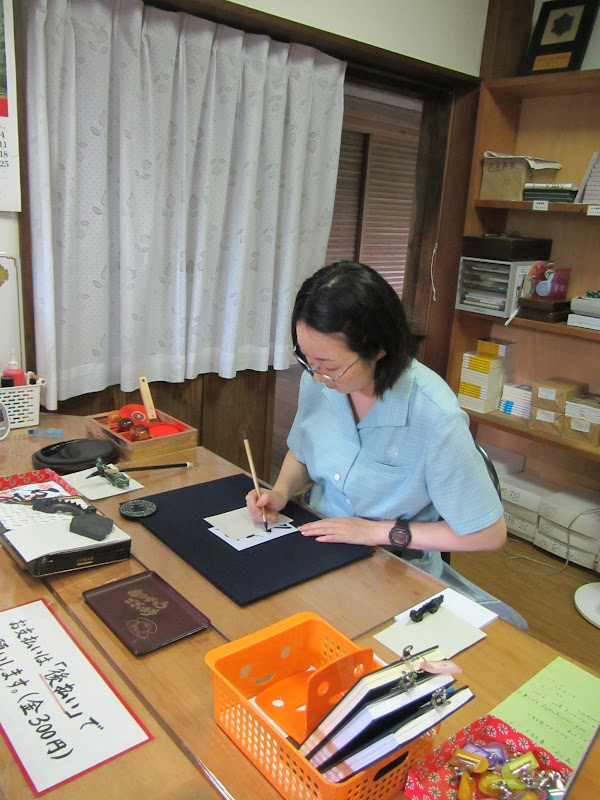
We stop for a minute at the souvenir shop, not to buy anything, but to watch a calligrapher at work. Then we stroll around the pretty
Kyoyochi Pond.
 |
| Calligrapher at work, Ryoanji Temple, Kyoto |
 |
| Kyoyochi Pond, Ryoanji Temple, Kyoto |
After quite a long ride involving two buses (they are getting pretty crowded, so we stand most of the time), we are at our final stop, the
Sanjusangen-do. Officially called the
Rengeo-in Temple, it was built in the 12th century, then, after a devastating fire, rebuilt in 1,266. The temple hall is long, it measures 120 meters (394 feet), and it's unofficial name of Sanjusangen-do refers to the fact that there are 33 bays between the columns inside.
The most interesting is not the building however, but it's contents. As soon as we walk in we gasp, amazing! The hall houses 1,001 statues of the Buddhist deity
Juichimen-senju-sengen Kanzeon, mostly just called by the simple name
Kannon. There are 1,000 standing Kannon statues and one huge sitting one. They are made of Japanese cypress and 124 of them are original, saved from the fire which destroyed the building. The rest of them are 13th century replacements. Even more fun to look at are the 28 statues of
guardian deities, placed in line in front of the 1,000 Kannon statues.To my Western eyes they look like bizarre cartoon characters, a lot of fun to look at. On both sides they are flanked by the impressive
Thunder God and
Wind God statues. Too bad that photography is not allowed inside, I would have really liked to show you all these, it's very impressive.
 |
| Sanjusangen-do, Kyoto |
We walk out to the outside gallery of Sanjusangen-do, which is used for an annual archery competition, the
Toshi-ya Matsuri, when competitors shoot arrows alongside the entire length of the hall.
 |
| Outside gallery of Sanjusangen-do where archer competitions take place, Kyoto
|
We were planning to see one more temple, but it's raining heavily and we are exhausted, so we call it a day. Of course we haven't seen everything there is to see in Kyoto. Already at home, when I was preparing this trip, I realized that Kyoto has an overwhelming number of temples and other historic sites. I am a little disappointed that we didn't get to see the 19th century reconstruction of the Imperial Palace, but's it's not open over the weekend. I would have also liked to visit Gion, Kyoto's famed geisha district. Perhaps some other time.
We take a very crowded bus to the train station, we stand the entire time. Then a 30 minute ride on a very crowded local train to Osaka, again we stand all the way. I am so glad our hotel is just across the street from Osaka station!